
11 min read
If your roof has developed dark streaks, black patches, or crusty growths that weren’t there a few years ago, you’re not alone. Biological staining is one of the most common roof issues in Perth, and while it looks concerning, the cause is almost always one of three organisms - algae, lichen, or mould. Each looks different, causes different levels of damage, and requires a different approach to treatment.
Understanding which one you’re dealing with is the first step to deciding what to do about it.
The Three Main Causes
Gloeocapsa Magma (Algae) - Dark Streaks
Those distinctive dark streaks running down from the ridge line toward the gutters? That’s almost certainly Gloeocapsa magma, a species of cyanobacteria commonly called roof algae. It’s the single most common cause of dark staining on roofs across Perth and indeed most of Australia.
What it looks like: Dark grey to black streaks that follow the path of water runoff down the roof. The staining is typically darkest near the ridge and lightens toward the gutters. In early stages, it appears as faint grey discolouration. Over time, it darkens to near-black.
How it grows: Gloeocapsa magma feeds on the calcium carbonate in concrete roof tiles and the limestone filler used in many roofing materials. It produces a dark protective coating (the melanin-rich sheath that gives it its dark colour) to shield itself from UV radiation. The darker the stain, the more established the colony.
Why it streaks: Rain washes dead algae cells and their dark pigment down the roof surface. The streaks follow the natural drainage patterns of the roof, which is why the staining runs vertically down from high points.
How fast it spreads: Algae is slow but relentless. You might notice faint discolouration after 3-5 years on a new or freshly painted roof, progressing to heavy staining over 8-15 years. Once established on one section, it spreads across the entire roof - but always with a bias toward sections that stay damp longest.
Lichen - Crusty Patches
Lichen is a composite organism - a partnership between fungi and algae living together. It’s the most damaging of the three common biological growths found on Perth roofs.
What it looks like: Crusty, irregular patches that are usually light grey, pale green, orange, or white. Lichen has a rough, textured surface that’s distinctly different from the smooth staining of algae. It forms circular or irregular patches that expand outward over time. Some species form flat crusts, while others develop a more leafy, three-dimensional structure.
Why it’s different from algae: While algae sits on the surface, lichen physically anchors itself into the tile material. It sends root-like structures (rhizines) into the surface of the tile, creating tiny pits and channels. Over years, this causes measurable surface erosion.
Where it’s found: Lichen prefers stable, undisturbed surfaces with consistent light. It’s most commonly found on south-facing roof sections in Perth (less direct sun, more consistent moisture), along ridges, and around the edges of tiles where moisture lingers.
Mould - Fuzzy Growth
Mould on roof surfaces is less common than algae or lichen but can indicate underlying moisture problems that warrant investigation.
What it looks like: Dark, fuzzy or powdery growth, usually black or dark green. Unlike the smooth staining of algae or the crusty texture of lichen, mould has a distinctly organic, soft appearance. Under magnification, you can see the branching filaments (hyphae) that make up the mould colony.
What it indicates: Mould needs consistent moisture to thrive. On a roof surface that dries out in the Perth sun, mould struggles to establish unless there’s a persistent moisture source - poor drainage, blocked gutters creating damp areas, or condensation from poor ventilation. If you see significant mould growth on your roof, the mould itself is less concerning than the moisture condition that’s supporting it.
How to Tell Them Apart
Identifying which organism you’re dealing with isn’t difficult once you know what to look for:
| Feature | Algae | Lichen | Mould |
|---|---|---|---|
| Texture | Smooth, flat staining | Crusty, rough patches | Fuzzy, soft |
| Colour | Dark grey to black | Grey, green, orange, white | Black or dark green |
| Pattern | Vertical streaks | Circular/irregular patches | Patches in damp areas |
| Surface | Wipes off (when wet) | Firmly attached | Brushes off easily |
| Location | Rain-wash areas | Stable, undisturbed areas | Persistently damp spots |
In practice, many Perth roofs have a combination of all three, especially older roofs that haven’t been maintained. The south-facing slope might have heavy lichen, the north face might show algae streaks, and the areas around blocked gutters might have mould.
Why Perth Roofs Get Biological Growth
Perth’s climate creates conditions that favour biological growth on roofs, despite the hot, dry summers. Several factors contribute:
South-Facing Sections Stay Damp Longer
In the southern hemisphere, south-facing roof slopes receive less direct sunlight. During Perth’s wet winter months (May to August), these sections can stay damp for days at a time. The reduced UV exposure also means less natural sterilisation of the surface. This is why biological growth is almost always worst on the south-facing slope.
Trees Create Shade and Debris
Overhanging trees shade sections of the roof, reducing the drying effect of sun and wind. Leaf litter accumulates in valleys and behind tiles, holding moisture against the tile surface and providing organic material for organisms to feed on.
Trees also contribute airborne spores. Algae, lichen, and mould all reproduce via microscopic spores that land on the roof, and nearby trees increase the density of biological material in the air around your home.
Perth’s Winter Rainfall Pattern
Perth’s rainfall is concentrated in winter - roughly 80% of annual rainfall occurs between May and October. This gives biological organisms a solid five to six months of consistent moisture to grow, followed by a hot, dry summer that slows but doesn’t eliminate growth. Established colonies survive summer dormancy and resume growth when the rains return.
Poor Roof Ventilation
Roofs with inadequate ventilation trap moisture in the cavity, which can contribute to condensation on the underside of tiles. This keeps tile surfaces damp from both sides - rain from above and condensation from below. The result is a tile surface that stays moist longer, favouring biological growth.
Age and Surface Condition
New or freshly painted roof tiles have a smooth, sealed surface that’s relatively resistant to biological colonisation. As the surface weathers, it becomes rougher and more porous, providing better attachment points for organisms. The older and more weathered the tile surface, the faster biological growth establishes.
Are They Actually Damaging Your Roof?
This is the question that matters, and the answer depends entirely on which organism you’re dealing with.
Algae: Mostly Cosmetic
Algae staining is primarily a cosmetic issue. It doesn’t significantly damage tile surfaces or reduce the functional lifespan of the roof. It does, however, make the roof look terrible. A heavily algae-stained roof can make an entire property look neglected and is one of the first things buyers notice when viewing a home.
The dark staining also reduces the reflectivity of the roof, which means slightly higher heat absorption in summer - but the practical temperature difference is marginal.
Lichen: Causes Real Damage
Lichen is the one to worry about. Because it physically roots into the tile surface, lichen causes cumulative damage over time:
- Surface pitting - the rhizines create small cavities in the tile surface that don’t heal when the lichen is removed
- Increased porosity - pitted surfaces absorb more water, accelerating further weathering
- Paint adhesion failure - if you paint over lichen-damaged surfaces without proper preparation, the coating fails prematurely because the substrate is compromised
- Tile weakening - severe lichen damage over decades can measurably thin the surface layer of concrete tiles
Lichen-damaged tiles can still function as a waterproof roof covering for many years, but the surface damage is irreversible. Early treatment prevents the damage from progressing.
Mould: The Symptom, Not the Disease
Mould on the roof surface is usually the symptom of a moisture management problem rather than a cause of damage in itself. Addressing the mould without fixing the underlying moisture issue means it will return.
Common underlying causes include blocked gutters creating standing water near the roof edge, poor cavity ventilation trapping humid air, and insufficient fall on flat sections allowing water to pool.
How to Clean Biological Growth
Pressure Cleaning
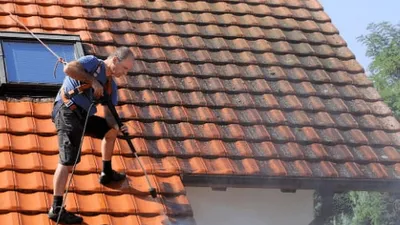
High-pressure water cleaning is effective at removing all three types of biological growth. When done correctly, it strips the roof surface back to clean tile, removing staining, lichen, and mould along with loose surface material.
The key word is “correctly.” Pressure cleaning a roof requires proper technique - working from the ridge down, holding the nozzle at the right angle, and using appropriate pressure for the tile type. Too much pressure damages tiles. Wrong angle drives water under tiles and into the cavity.
This is absolutely a professional job. The combination of high-pressure equipment, height, wet slippery tiles, and the need for proper technique makes DIY pressure cleaning dangerous and often counterproductive.
Soft Wash (Chemical Treatment)
Soft washing uses a sodium hypochlorite solution (essentially a strong bleach) applied at low pressure to kill biological growth. The organisms die, and the staining fades over weeks as rain washes away the dead material.
Advantages of soft washing include lower risk of tile damage (no high-pressure impact), effectiveness against deeply rooted lichen, and longer-lasting results because the chemical kills organisms at the root level rather than just stripping the surface growth.
The trade-off is that results aren’t instant - the roof doesn’t look dramatically better the next day. Full results take 4-8 weeks as dead material breaks down and washes away.
What About Vinegar, Bleach from the Supermarket, or Other DIY Solutions?
Household bleach (sodium hypochlorite) is the same active chemical used in professional soft wash treatments, but at a much lower concentration. You can kill surface algae with it, but you need to get it on the roof - which means climbing up there with a sprayer, working on potentially slippery tiles, and applying it evenly. The risks outweigh the savings.
Vinegar is sometimes recommended online but is largely ineffective against established lichen and provides no lasting protection.
Preventing Biological Growth
Zinc Strips
Zinc strips installed along the ridge line release zinc ions when it rains. The zinc-laden water runs down the roof surface and inhibits algae and lichen growth. This is a well-established prevention method that works passively for 10-20 years.
Zinc strips don’t remove existing growth - they prevent new growth on clean surfaces. They’re most effective as part of a maintenance program: clean the roof, install zinc strips, and the roof stays cleaner for much longer.
Improved Ventilation
If moisture retention is contributing to biological growth, improving roof cavity ventilation helps. Whirlybirds, ridge vents, or eave vents increase airflow through the cavity, reducing humidity and condensation. This makes the environment less hospitable for mould in particular.
Tree Management
Trimming overhanging branches is one of the most effective preventive measures. More sunlight and airflow on the roof surface means faster drying after rain, which dramatically reduces biological growth. Even trimming branches back a couple of metres can make a noticeable difference.
Roof Coating
A quality roof coating or paint system seals the tile surface, making it smoother and less hospitable to biological colonisation. A freshly coated roof stays cleaner for much longer than an uncoated weathered surface. As the coating weathers over years, the surface gradually becomes more susceptible again - which is one of the reasons roof coatings need renewal every 10-15 years.
Why Painting Over Biological Growth Fails
This is worth a dedicated section because it’s a mistake we see regularly. A homeowner or inexperienced painter sees a dirty, stained roof and decides to paint over it rather than cleaning it properly first.
The result is predictable: the paint fails within 1-3 years.
Here’s why. Paint needs to bond to a clean, stable substrate. Biological growth - particularly lichen - creates a layer between the tile and the paint that is not stable. The lichen continues to grow under the paint, lifting it from the surface. Algae staining contains organic material that prevents proper adhesion. Mould beneath paint continues to grow, creating bubbles and delamination.
Any professional roof coating system starts with thorough cleaning - pressure cleaning to remove all biological growth, followed by treatment of stubborn lichen if required. Only once the surface is genuinely clean and prepared should primer and topcoat be applied.
Skipping the preparation to save money or time doesn’t save either - it just means doing the job again in two years instead of ten.
The Bottom Line
Black stains and streaks on your roof are almost always biological in origin - algae, lichen, or mould. Algae is the most common and is primarily cosmetic. Lichen is less common but more damaging because it physically roots into the tile surface. Mould usually indicates an underlying moisture issue that needs addressing.
All three can be effectively treated with professional cleaning, and preventive measures like zinc strips, tree management, and good ventilation can slow their return significantly. The one thing you shouldn’t do is ignore lichen or paint over any biological growth without proper cleaning first - both approaches lead to worse outcomes down the track.
If your roof is looking dark and stained, a professional roof clean and assessment is the sensible starting point. It addresses the cosmetic issue, reveals the true condition of the tiles underneath, and gives you the information you need to decide on the best path forward. Get a free quote online to get it sorted.

 Licensed
  Fast Response
