6 min read
Metal roofs are popular in Perth for good reason - they’re lightweight, handle heat well, and last decades with minimal maintenance. But they’re not maintenance-free, and rust is the primary threat to their longevity.
Catching rust early is the difference between a roof you can still clean and repaint and one that needs an expensive reroof.
Why Metal Roofs Rust in Perth
Modern Colorbond and Zincalume roofing has multiple layers of protection: a steel core coated with aluminium-zinc alloy, then a primer, then a baked-on paint finish. When all those layers are intact, the steel underneath never contacts moisture and never rusts.
Rust starts when those protective layers are breached. In Perth, the most common causes are:
Scratch and Impact Damage
During installation, maintenance, or from falling branches, the paint and zinc layers get scratched or dented. Even a small scratch that exposes the steel is a starting point for corrosion. Perth’s occasional hailstorms can cause hundreds of tiny impact points across a roof.
Salt Spray (Coastal Suburbs)
Salt deposits on the roof surface accelerate corrosion dramatically. Suburbs within 5km of the coast - Scarborough, Cottesloe, Hillarys, Rockingham - see significantly higher corrosion rates. Salt attacks the zinc layer that protects the steel, and once the zinc is consumed, rust follows quickly.
Cut Edges
Every piece of roofing has cut edges where the steel core is exposed. During manufacturing, these edges are designed to self-protect through a process where the zinc coating “creeps” over the edge. But in aggressive environments (coastal, industrial), the zinc is consumed faster than it creeps, and the cut edges begin to rust.
This is why you often see rust starting at sheet overlaps, ridge cap edges, and flashing terminations - anywhere there’s a cut or folded edge.
Dissimilar Metal Contact
When different metals touch in the presence of moisture, galvanic corrosion occurs. The most common example in Perth is steel screws in Colorbond sheeting, or copper pipe flashings against steel roof sheets. One metal sacrifices itself to protect the other, and the result is accelerated corrosion.
Age and UV Degradation
Even without any of the above factors, the paint and zinc layers degrade over time under Perth’s intense UV radiation. The paint chalks and thins, the zinc layer is slowly consumed by normal atmospheric corrosion, and eventually the protection is insufficient.
For a standard Colorbond roof in Perth’s climate:
- 0-15 years: Protection layers intact, minimal maintenance needed
- 15-25 years: Paint fading and chalking, zinc layer thinning, first signs of corrosion possible in vulnerable areas
- 25-40 years: Restoration recommended to renew protective coating before rust establishes
- 40+ years: Assessment needed - restoration if structurally sound, replacement if widespread corrosion
Spotting Rust Early
Regular visual checks from ground level catch rust before it becomes structural:
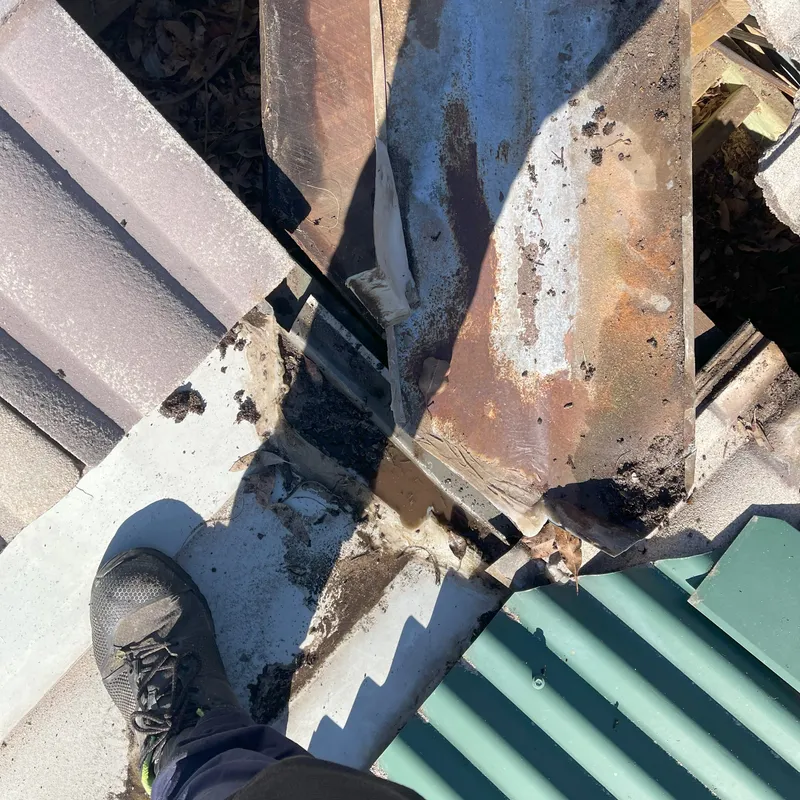
Surface rust - Orange-brown discolouration on the visible surface. This is often surface-only and easily treated if caught early.
Edge rust - Rust forming along ridges, overlaps, and sheet edges. Visible as a line of brown along what should be a clean metal edge.
Rust staining - Brown streaks running down the roof from a rust source higher up. You might see the staining before you spot the rust itself.
Blistering or bubbling paint - The paint lifts away from the surface as rust forms underneath. By the time you see bubbles, rust has already established beneath.
Fastener rust - Screws and their washers rusting. This is extremely common and one of the earliest signs. Roofing screws have a limited life and often corrode before the sheets do.
Treatment Options
Surface Rust (Cosmetic, No Perforation)
If the rust is surface-only and the metal underneath is still solid:
- Wire brush or sand the rusted area back to clean, bright metal
- Apply a rust converter (phosphoric acid-based) that chemically transforms rust into a stable compound
- Prime with a zinc-rich metal primer to restore sacrificial protection
- Topcoat with a quality roof paint matched to the surrounding colour
For a few isolated spots, this is a DIY-feasible repair with products from Bunnings. For a roof that’s weathered and faded across the board but still sound underneath, a professional clean and repaint is the more practical route and gives a consistent finish.
Corroded Fasteners
Corroded screws eventually need replacing with new ones. The new screw goes in the same hole or immediately adjacent, with a fresh neoprene washer to reseal the penetration.
It’s fiddly work - over-tightened screws crack the washer and create leaks, under-tightened screws allow water ingress - and it’s separate from a clean and repaint. Worth knowing a repaint doesn’t fix failed fasteners: if your screws are the problem, that’s a fastener job in its own right, not part of a metal roof clean and repaint.
Full Metal Roof Restoration
For a roof with widespread paint failure and chalking but sound steel underneath, a full clean and repaint is the most cost-effective way to renew the protective coating:
- High-pressure clean to remove all chalk, loose paint, and surface grime
- Prime with a metal roof primer for a sound, even base
- Apply two coats of metal roof membrane in your chosen colour
This renews the protective barrier and extends the roof’s life by 15-20 years. It’s a fraction of the cost of a reroof and appropriate for any metal roof that’s structurally sound but cosmetically deteriorated.
When Restoration Isn’t Enough
Some damage is beyond restoration:
- Perforated sheets - if you can see holes or push a screwdriver through rusty areas, the steel is consumed and that section needs replacing
- Widespread structural rust - if more than 10-15% of the roof area has deep rust, replacement is usually more cost-effective than patching dozens of sections
- Valley and gutter corrosion - heavily corroded valleys must be replaced, not coated over. The coating won’t bridge holes or restore structural integrity to thinned metal.
Prevention for New or Restored Roofs
Once you have a sound roof (new or freshly restored), prevention is straightforward:
Annual wash. A gentle hose-down once or twice a year removes salt deposits, dirt, and leaf tannin that accelerate corrosion. This is especially important within 5km of the coast.
Trim overhanging trees. Leaf litter on metal roofs traps moisture and creates acidic conditions under the debris. Branches scratching the surface also damage the coating.
Check fasteners every 5 years. Screws are the weak point. A visual check from inside the cavity (look for rust stains on the underside of screws) catches failures before they leak.
Address scratches immediately. Touch up any scratches or damage to the coating promptly. A $20 tin of touch-up paint applied in the first week prevents a $200 repair three years later.
Avoid dissimilar metals. If you’re adding anything to the roof (TV antenna, solar panels, satellite dish), ensure the mounting hardware is compatible with the roof material. Stainless steel fasteners in Colorbond are generally fine; copper, brass, or bare steel are not.
The Bottom Line
Rust on a metal roof isn’t a death sentence - it’s a maintenance signal. Caught early, it’s inexpensive to treat. Left for years, it becomes a structural problem that eventually requires a full reroof.
The key is regular observation and timely action. If your metal roof is past the 20-year mark and you’re seeing paint deterioration or early rust, now is the time to get it assessed - before the rust advances to the point where simple restoration becomes a more complex and costly project. A full metal roof restoration renews the protective coating and buys you another 15 to 20 years. Get a free quote and we’ll take a look.
 Licensed
  Fast Response
