6 min read
If you’ve ever had a roofer look at your roof and say “the pointing’s gone,” you might have wondered what they’re talking about. Pointing is one of those roofing terms most homeowners haven’t heard until something goes wrong.
But it’s critically important - failed pointing is the single most common cause of roof leaks in Perth tile roofs.
What Is Roof Pointing?
Pointing is the flexible compound that seals the gaps between ridge caps (the shaped tiles running along the peaks of your roof) and the roof tiles below them.
To understand pointing, you need to understand the two-part system that holds ridge caps in place:
Bedding - a thick layer of sand-and-cement mortar that the ridge caps sit on. This is the structural base that holds the caps in position.
Pointing - a flexible compound applied over the bedding at the edges where ridge caps meet the roof tiles. This seals the joints and prevents water from entering.
Think of bedding as the foundation and pointing as the weatherproof seal on top.
Why Does Pointing Fail in Perth?
Perth’s climate is particularly harsh on roof pointing. Here’s why it fails:
Thermal Cycling
Perth’s extreme temperature swings - often 15-20 degrees between overnight lows and afternoon highs - cause constant expansion and contraction. Over years, this repeated movement cracks and breaks the pointing compound.
This is why Perth roofs need repointing more frequently than roofs in cities with milder temperature ranges.
UV Degradation
Perth receives intense UV radiation year-round. UV breaks down the polymers in pointing compounds, making them brittle and prone to cracking. North and west-facing ridge lines typically fail first because they cop the most direct sun.
Old Cement-Only Pointing
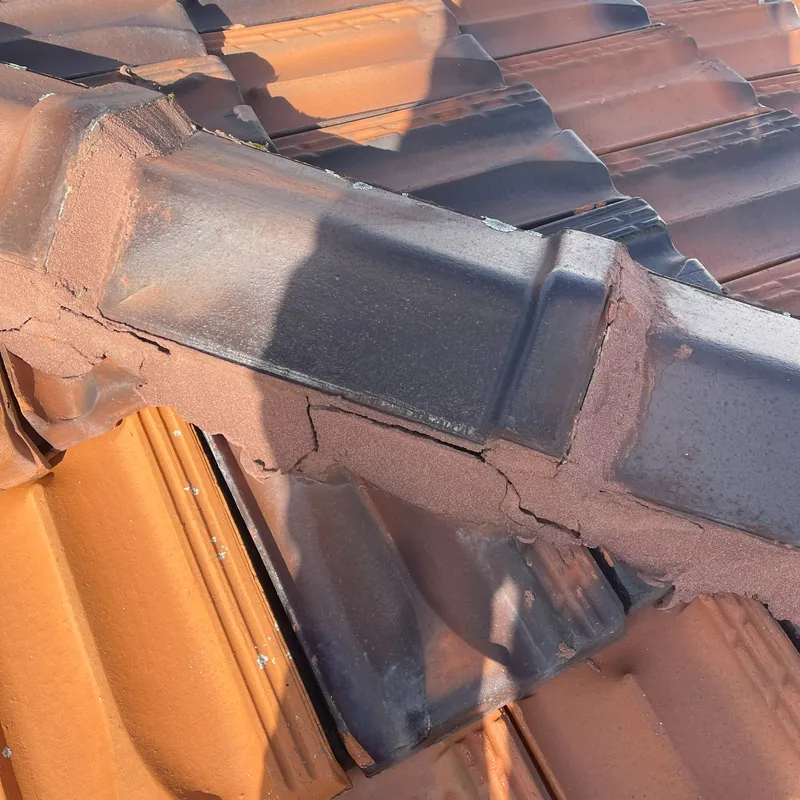
Many older Perth homes were originally pointed with straight cement mortar - not a flexible compound. Cement is rigid and cannot flex with thermal movement. It’s essentially guaranteed to crack, and most cement-pointed roofs over 20 years old have significant pointing failure.
Modern flexible pointing compounds are specifically designed to move with the roof, but they still have a finite lifespan.
Tree Damage
Branches rubbing against or falling onto ridge caps can crack pointing and displace caps. Leaf debris sitting against pointing can also trap moisture and accelerate deterioration.
How to Spot Failed Pointing
You can check your pointing from ground level with binoculars, or by walking around your property and looking up at the ridge lines:
- Visible cracks running along the pointing
- Chunks of pointing material on the ground or in gutters
- Gaps between the pointing and the ridge cap or tiles
- Dark staining on the ridge line suggesting water is penetrating
- Ridge caps that look uneven or have shifted position
If you can see daylight through gaps in the ridge line, water is definitely getting through when it rains.
What Happens If You Ignore It
Failed pointing is a slow-motion leak source. Here’s the typical progression:
- Small cracks develop - water occasionally seeps through during heavy rain
- Cracks widen - more water enters, staining the ceiling below
- Bedding deteriorates - water reaching the bedding breaks it down, loosening the ridge caps
- Ridge caps shift - loose bedding means caps can move in wind, opening larger gaps
- Timber damage - persistent moisture causes mould and rot in the roof framing
- Major leak - what started as a minor pointing issue becomes a significant water entry point
The cost of repointing at stage 1 might be $1,800-$4,000. By stage 5, you’re potentially looking at timber replacement, ceiling repairs, and mould remediation costing $5,000-$15,000+.
The Repointing Process
Professional repointing follows a specific process:
1. Remove Old Pointing
All cracked and failed pointing is carefully removed using hand tools. This reveals the bedding underneath and any ridge caps that have shifted.
2. Assess the Bedding
If the bedding mortar is still intact and holding the caps firmly, it can stay. If it’s crumbled or broken, the affected ridge caps need to be lifted and re-bedded with fresh mortar.
3. Re-bed Where Needed
Damaged bedding is chipped out and replaced with a fresh sand-and-cement mortar bed. The ridge cap is repositioned on the new bed and held in place while it sets.
4. Apply New Pointing
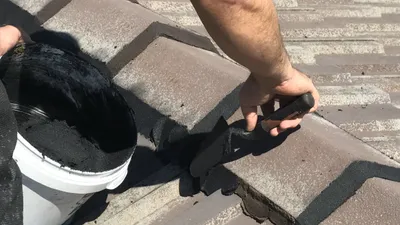
Flexible pointing compound is applied in a continuous bead along both edges of each ridge cap, sealing the gap between the cap and the roof tiles. The compound is tooled to create a neat, watertight finish.
5. Colour Match
Quality flexible pointing comes in a range of colours to match your roof. A well-done repointing job should be barely noticeable - the pointing blends with the surrounding roof colour.
Flexible Pointing vs Cement Pointing
If anyone offers to repoint your roof with straight cement, politely decline. Cement pointing will crack again within a few years due to thermal movement.
Flexible pointing compounds like Starpoint are specifically formulated to:
- Stretch and compress with thermal movement without cracking
- Resist UV degradation and fading in Perth’s intense sun
- Maintain adhesion to both cement bedding and tile surfaces
- Remain watertight for 15-20+ years
- Seal the ridge line against wind-driven rain without cracking as the roof moves
One thing worth being clear about: flexible pointing is a sealant, not a mechanical fixing. In cyclonic wind areas the ridge and hip tiles themselves have to be mechanically fixed - clipped or screwed - and the pointing seals that joint rather than replacing the fixing. Perth is not a cyclonic zone, but it is worth knowing what the pointing is and is not doing.
Starpoint is a pure acrylic compound that is water resistant within 2 hours of application and backed by a 10-year manufacturer warranty. The material costs a bit more than cement, but the longevity difference is dramatic.
How Much Does Repointing Cost?
For a typical Perth home, repointing costs vary based on:
- Length of ridge line - more ridge, more pointing needed
- Condition of bedding - if re-bedding is needed, costs increase
- Accessibility - steep roofs or multi-storey homes cost more
- Extent of damage - partial repointing vs. full ridge repointing
Rough guide for Perth:
- Partial repointing (just damaged sections): $1,500-$2,500
- Full ridge repointing: $1,800-$4,000
- Full repointing with re-bedding: $3,000-$6,000
Partial repointing isn’t much cheaper than doing the whole ridge line, and that surprises people. The reason is that the bulk of the cost is the visit itself - a full day, the crew, the truck, the travel and the trade insurances behind it - not the few extra buckets of compound. Once we’re up there, doing the entire ridge line usually costs little more than patching one section, and it resets the clock on the whole roof rather than just one part of it.
These figures are for labour and materials. If repointing is done as part of a full roof restoration, the cost is typically included in the overall restoration price.
When to Get It Done
If your Perth home has a tile roof more than 15 years old, there’s a strong chance some pointing needs attention. The best approach is:
- Get a professional roof inspection
- Address failed sections promptly with repointing or rebedding
- If most of the pointing is failing, a full repoint during a roof restoration is the most cost-effective approach
Don’t wait until you see water stains on your ceiling. By then, the damage has already been done.

 Licensed
  Fast Response
